



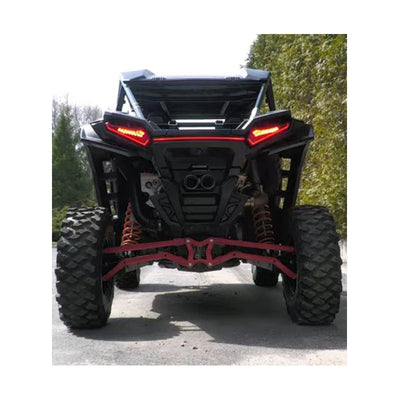
How Exhaust Systems Affect SxS Power Output: What Is Real and What Is Marketing
 How Exhaust Systems Affect SxS Power Output: What Is Real and What Is Marketing
The claims range from modest to outlandish. Here is how to separate the two.
Power claims attached to aftermarket SxS and UTV exhaust systems can be hard to evaluate. Some manufacturers lead with dyno numbers. Others use vague language like "significant power gains" without any data to support it. For a rider trying to make an informed purchase, sorting out what is real versus what is marketing copy requires some baseline understanding of how exhaust systems interact with engine performance.
This is not a deep dive into fluid dynamics or combustion theory. It is a practical explanation of the mechanisms involved and how to think about performance claims when you are shopping.
The Basic Relationship Between Exhaust Flow and Power
 An internal combustion engine produces power by burning a fuel-air mixture and converting the resulting expansion into mechanical energy. After combustion, the exhaust gases need to exit the engine as efficiently as possible so the next combustion cycle can begin cleanly. Anything that impedes thatexit reduces the engine's efficiency.
This is where exhaust system design matters. A more restrictive exhaust creates backpressure, which means the engine has to work harder to push exhaust gases out. A less restrictive exhaust reduces that work, allowing the engine to breathe more freely and extract more useful energy from each combustion event. The result is typically better throttle response and more usable power across the RPM range.
The inverse is also true to a point. An exhaust with too little restriction can actually hurt low-end torque because some backpressure helps scavenging at certain RPM ranges. Well-engineered aftermarket exhausts are tuned to reduce restriction strategically, not eliminate it entirely.
What a Well-Engineered Aftermarket Exhaust Actually Does
The primary performance contribution of a quality aftermarket exhaust is improved flow efficiency compared to the stock unit. As discussed in our piece on OEM exhaust design, stock systems are tuned for regulatory compliance and broad market requirements, which often means leaving flow performance below optimal levels for an enthusiast application.
An aftermarket system designed for the specific engine and chassis of your SxS can optimize flow characteristics in ways the OEM system cannot. The internal geometry, pipe diameter, and collector design are all tunable variables. A manufacturer who specializes in exhaust engineering uses those variables deliberately.
The performance improvement that results is real, but its magnitude depends on the specific application. For a naturally aspirated engine with modest stock restrictions, the gains from an exhaust upgrade alone may be noticeable but not dramatic. For a turbocharged application or an engine that is heavily restricted from the factory, the gains can be more significant.
How to Read Power Claims Honestly

When a manufacturer claims specific horsepower gains from an exhaust upgrade, the relevant questions are where those numbers came from and under what conditions they were measured. Dyno testing can be conducted in ways that produce impressive-looking numbers that do not reflect real-world riding. Full-system exhausts, which replace the header and the muffler, produce larger gains than slip-on muffler replacements. Claims made for a full system should not be applied to a muffler-only upgrade.
The testing conditions also matter. A dyno run that includes a tune, an air intake upgrade, and an exhaust upgrade cannot attribute all of its gains to the exhaust alone. Some manufacturers make claims based on combined modification packages without being clear about which component contributed what.
The most credible performance claims are specific about the testing methodology, reference the baseline (stock) measurements, and state clearly what configuration was used during testing. Vague language about significant power gains or claims without supporting data should be taken with appropriate skepticism.
Where Exhaust Upgrades Deliver Their Best Results

For most SxS riders, the performance improvement from an aftermarket exhaust is felt most clearly in throttle response and mid-range pull rather than peak horsepower numbers. The engine feels more responsive, particularly coming out of corners or when accelerating from a partial throttle position. That improvement in drivability is often more meaningful in actual riding conditions than peak power gains measured at WOT on a dyno.
The sound character change is also a form of performance in the sense that it makes the machine more engaging to ride. A well-tuned aftermarket exhaust does not just sound different from stock. It sounds more like what the engine wants to sound like when it is not being constrained by an OEM system designed for the quietest acceptable output.
The Bottom Line

Aftermarket exhaust systems can deliver genuine performance improvements. The mechanism is real and well understood. The degree of improvement varies by application and by how good the engineering behind the specific system is.
What you should be skeptical of is unsupported claims, especially large horsepower numbers attached to muffler-only upgrades on engines that are not heavily restricted from the factory. What you should look for is a manufacturer who is specific and honest about what their product does, backed by data from rigorous testing.
The best exhaust upgrade is the one that delivers what it promises. For most riders, that means improved throttle response, better sound, and a system that holds up season after season. Those are achievable goals. The claims that go beyond them deserve a closer look before you buy.
|
Related Reading • What Stock Mufflers Are Actually Engineered For • Stock vs. Aftermarket SxS Exhaust: What Changes and What Does Not |
Leave a comment